







The campaign hit 100% funding. The stretch goals are unlocked. Your Discord server is a non-stop wall of hype. You’ve celebrated, had a drink, and then—if you’re like 90% of the indie designers we talk to about their Kickstarter TCG project—the 2 AM panic sets in.
You find yourself staring at your monitor, looking at the breathtaking, vibrant digital illustrations you spent months perfecting. Now comes the part that keeps creators awake: transferring that digital magic onto real, physical cardboard without losing its soul.
We talk to tabletop developers and startup publishers across the US every single day. The anxiety is never about game balance or playtesting; it’s about the factory floor. You’re terrified that your dark cyberpunk borders will show up with chipped edges, or that your legendary ultra-rare “chase cards” will end up looking like cheap metallic stickers.
We’re not a nameless sales email, and we don’t treat your game like just another batch of paper. We think like your production co-pilots. Let’s look at how the physical offset process actually works for a modern Kickstarter TCG, and how we protect your creative vision—and your margins—at a highly realistic 500-deck threshold.
🔍 Quick Answer (For the Scanners)
How do indie creators print retail-ready cold foil TCG cards without committing to thousands of dollars in waste? The secret to flawless, small-batch cold foil cards is hitting the 500 MOQ threshold with a factory that runs heavy offset presses (like Heidelberg). This gives you access to professional-grade setups—including custom K=100 Foil Mask files, 330gsm German Black Core paper, and micro-precision sharp die-cutting to prevent edge whitening—at a wholesale price point that keeps your Kickstarter margins incredibly healthy.
Trap #1: The “Whitening” Edge Disaster on Dark Kickstarter TCG Borders
If you’ve been scrolling through trading card subreddits or forums lately, you’ve probably seen players complaining about “edge whitening” or chipped borders on major retail card releases. If million-dollar brands are messing up their print runs, it’s no wonder indie creators are nervous.
Imagine opening your very first factory production box, flipping over a beautiful card with a deep, dramatic black border, and seeing microscopic white specks all along the edges. In the collector world, that card is dead on arrival. It will never catch a PSA 10 or BGS grading.
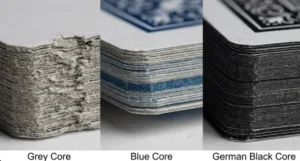
Here is what is actually happening behind the scenes on the shop floor: Standard print-on-demand (POD) shops use high-speed automated digital cutters. When that blade gets even slightly dull—and it gets dull fast—it doesn’t cleanly slice the cardstock. It violently slams into it. That impact shatters the brittle layer of ink right at the cut line, exposing the raw white paper core underneath.
How We Handle It in the Shop: We treat this with engineering precision. First, we refuse to use standard, rigid art cardstock that snaps and cracks under pressure. We standardize our high-tier TCG projects on 330gsm German Black Core paper. The fibers in this graphite-centered stock are incredibly resilient, offering that perfect “card snap” and shuffle feel players love. Second, our die-cutting molds are calibrated and checked every single day. The blade slices through the ink like a razor, leaving a glass-smooth, perfectly dark edge that preserves your full-art bleeds.
Trap #2: Why Cheap “Sticker Foil” Kills Your Kickstarter TCG Art
You want that legendary, multi-dimensional shimmer that catches the light when a player cracks open a booster pack. But if you walk into a generic local print shop asking for “holographic effects,” they are almost always going to quote you for Hot Stamping.
Think of hot stamping like a heated iron pressing an opaque foil sticker onto your card. Because it’s a 100% solid layer, it completely blankets the artwork underneath it. If you try to foil a wizard’s glowing staff, hot stamping covers the staff, the wizard’s face, and the background details in a blinding, flat sheet of chrome. It looks cheap, and it ruins your art.
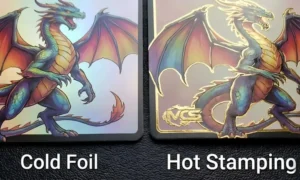
How We Handle It in the Shop: To compete with the industry giants, you need Cold Foil. With cold foil, we apply the metallic layer to the paper first, and then we run the sheets through our Heidelberg offset presses, printing your full-color CMYK artwork directly over the foil. Because offset inks are naturally translucent, the metallic reflection shines through your colors. Suddenly, your neon blues glow like electricity, your reds turn into metallic crimson, and the areas you want to keep matte—like character skin tones—remain completely soft, ink-rich, and untouched.
We don’t expect you to be a pre-press mastermind. Send us your layered artwork, and our team will work directly with you to build your K=100 Foil Mask file, manually mapping out exactly which pixels should catch the light and which should stay beautifully matte.
The 500 MOQ Sweet Spot: How to Actually Fund Your Next Kickstarter TCG Expansion
The question we get on almost every single inquiry is: “I’m just testing the market, can I just print 100 decks?”
We’re going to give you the honest answer that generic sales reps hide. Yes, you can find a digital printer to run 100 decks. But digital printing cannot handle cold foil masking, nor can it handle true 330gsm linen-textured core stock. You will end up getting charged highway robbery prices per unit for a product that feels like a home-printed prototype.
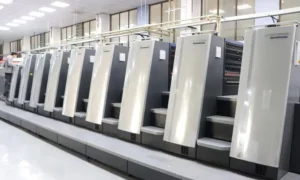
To turn on an industrial offset press, pressmen have to meticulously mix the inks, wash the rollers, and align the aluminum printing plates. That setup cost is fixed, whether you print one card or ten thousand.
The 500 MOQ threshold is the exact magic number where that fixed setup cost flattens out across your inventory. The cost-per-unit drops off a cliff. This gives your indie studio a massive tactical advantage:
-
Seamless Fulfillment: You easily cover your core Kickstarter backer tiers.
-
Retail Runway: You retain a healthy chunk of pristine inventory for conventions, retail store pitches, and webstore sales.
-
Real Cash Flow: Your profit margin per deck triples compared to low-tier digital printing, giving your studio the actual cash flow needed to fund your next expansion set.
Let’s Protect Your Backers Together
You did the hardest part of game design. You built a community from scratch, wrote the lore, and spent late nights tweaking the mechanics. You shouldn’t have to stay up at night worrying about bleeding margins, ink densities, and shipping tolerances.
We don’t want to just ship you a pallet of paper and walk away. We want to see your game succeed on local tabletop nights and YouTube unboxing channels. Let’s handle the heavy machinery while you focus on building your universe.
👉 [Submit Your Kickstarter Draft for a Free Pre-Press Review] (Ready to see how your art will look in the real world? Drop us a line with a link to your draft page or send over 1 or 2 of your card designs. Our pre-press engineering team will review your resolution, chat about your foil ideas, and provide a transparent, upfront quote for a professional 500-deck run on German Black Core stock. Let’s make something your players will keep forever.)