




A massive wave of panic is currently sweeping through the tabletop and esoteric creator communities. If you are an indie board game designer or a first-time Kickstarter creator gearing up for European fulfillment, you’ve likely heard the terrifying rumor: Every printed card deck entering the EU must now provide exact GPS coordinates of the forest where the paper was harvested.
Here is the precise, data-driven truth: Legally, no.
Under the latest EUDR (European Union Deforestation Regulation) updates, printed products classified under Chapter 49 (such as guidebooks and manuals) are explicitly excluded. Furthermore, playing cards, tarot decks, and board games fall under HS Code 9504.40—a category that has never been on the EUDR restricted list.
So, why are European ports still freezing pallets of indie card games every single week?

The Pain Point: The “Chapter 48” Administrative Trap
The sheer panic you are seeing in creator forums isn’t about the law changing. It is the direct result of a catastrophic administrative oversight by budget-tier factories and rushed freight forwarders.
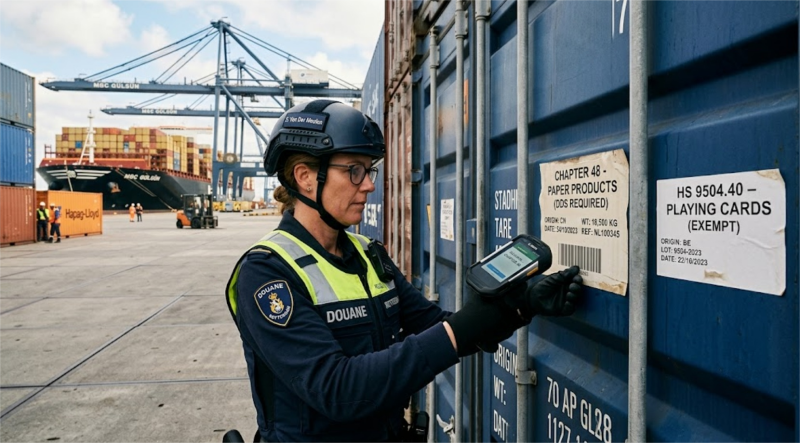
When shipping a beautifully crafted card game that includes a heavy rigid box, an inexperienced factory clerk will often lazily declare the entire shipment under HS Chapter 48 (General Paper Products or Standalone Packaging) simply because it requires less effort to file.
Here is where the nightmare begins: The moment the EU customs automated system flags a “Chapter 48” entry without a corresponding TRACES NT Due Diligence Statement (DDS), your shipment is instantly locked down. Customs officers will not open your boxes to appreciate your artwork. They will demand complex environmental credentials you do not have, and suddenly, your Kickstarter cargo is trapped on a damp dock in Rotterdam, hemorrhaging hundreds of Euros daily in demurrage fees.
Your beautifully crafted deck belongs in your backers’ hands—not in customs purgatory.
The Solution: Flawless Production Meets Strategic Compliance
Navigating international fulfillment requires a manufacturing partner who acts as an extension of your business. With over 10 years of specialized industry experience, we know that producing a successful tabletop game requires equal parts engineering precision and supply chain expertise.
Here is how we eliminate the guesswork and protect your campaign:
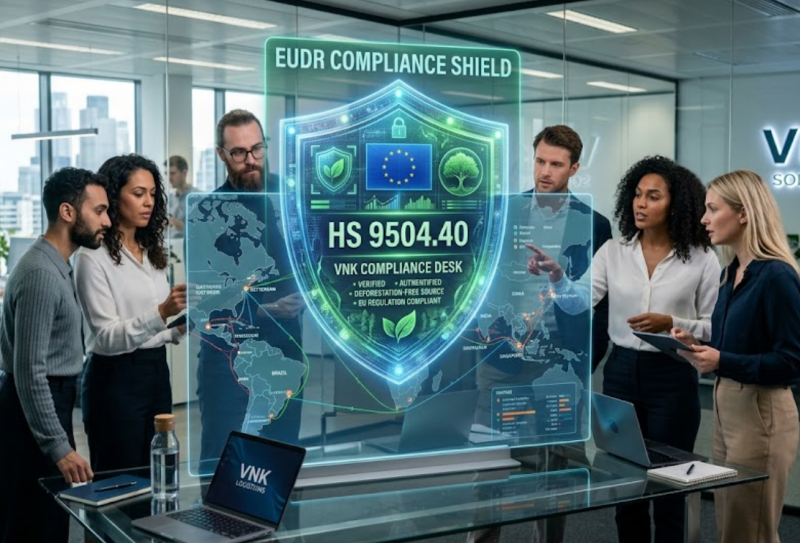
1. Dedicated 1-on-1 Project Management Unlike budget factories that treat you as a transaction, we assign a dedicated, 1-on-1 professional project manager to your campaign. From pre-press file checks to final logistics, your PM ensures zero communication barriers. Before your shipment ever leaves our dock, our documentation team rigorously reviews your commercial invoice, packing list, and bill of lading. We guarantee your custom games are precisely declared under HS 9504.40, completely bypassing false EUDR flags and administrative chaos.
2. World-Class Manufacturing at an Indie Scale You shouldn’t have to be a multinational publisher to access premium quality. We offer a highly competitive 500-set Minimum Order Quantity (MOQ), giving indie studios direct access to our state-of-the-art German Heidelberg printing presses. We guarantee museum-grade color calibration, razor-sharp artwork reproduction, and zero registration errors.
Value Proof: Winning at European Retail
Getting past the border is only half the battle; you still need to win over the market. Premium concept stores in Stockholm, esoteric boutiques in Milan, and major German tabletop distributors have ruthless procurement policies. If your deck lacks traceable environmental credentials and a premium tactile feel, it won’t survive on retail shelves.
We engineer your games for retail dominance:
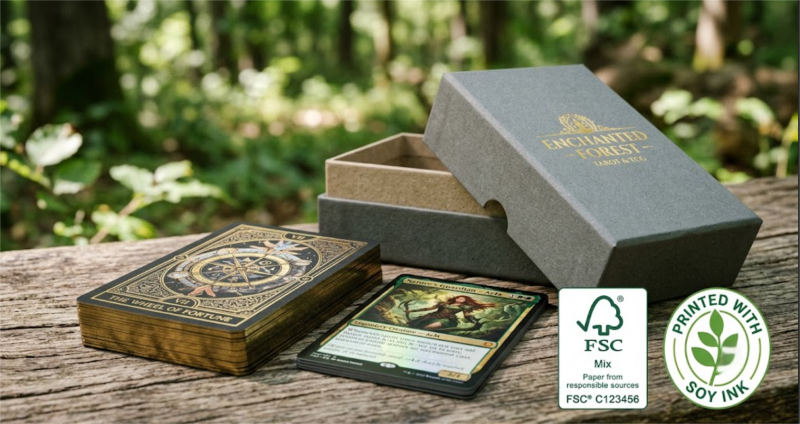
Industrial Precision: We build our premium European runs using exacting specs—330gsm German Black Core paper for ultimate snap and opacity, paired with 1200gsm high-density greyboard to ensure flawless vacuum suction and durability on your rigid boxes.
Uncompromised Ethics: Every sheet of cardstock and millimeter of greyboard we source is 100% FSC Certified, printed exclusively with 100% soy-based inks.
When a strict European buyer turns your box over, they don’t just see a game. They see a premium, sustainable, and fully compliant retail product.
Secure Your EU Customs Safe-Pass Today
We know how much heart, time, and capital goes into your artwork and crowdfunding campaign. Do not let months of creative passion get derailed by a careless typo on a factory customs form.
Stop leaving your logistics and brand reputation to chance.
Send your project specifications (target deck size, box style, card count, and estimated volume) to our engineering team today. For high-end custom card sets starting at just a 500 MOQ, your dedicated project manager will provide a precise, all-inclusive production quote.
Take action now: Contact us today, and we will include our exclusive 2026 EU Customs Safe-Pass Checklist—detailing the exact HS classification codes and documentation you need to guarantee a frictionless European fulfillment.
FAQ
Q1: Do I need a TRACES NT account to ship custom playing cards to the EU?
A: No. Custom playing cards, TCGs, and tarot decks fall under HS Code 9504.40, which is officially exempt from the EUDR and does not require a TRACES NT account or a Due Diligence Statement (DDS). However, precise customs declaration by your manufacturer is strictly required to avoid cargo freezes.
Q2: Why are board games and indie decks getting stuck in EU customs for EUDR?
A: Most delays are caused by the “HS Code Trap.” When factories misclassify custom games packaged in rigid boxes as “Chapter 48” (general paper products or standalone packaging), it triggers an automatic EUDR system flag. Customs will freeze the cargo until complex compliance paperwork is provided.
Q3: Does my Kickstarter tarot deck need to be FSC Certified for European fulfillment?
A: Legally, your deck is exempt from EUDR border checks under HS 9504.40. However, commercially, almost all premium European retail stores and major tabletop distributors now strictly require 100% FSC-certified materials (like German Black Core and high-density greyboard) to meet their internal sustainability policies.