






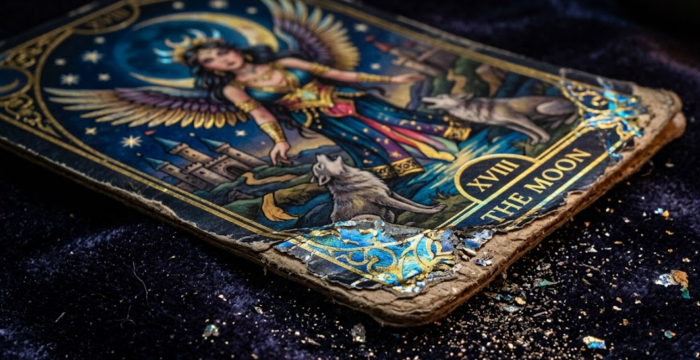
If a manufacturer tells you that holographic edges flaking off after a few riffle shuffles is “just a normal physical reaction,” they are lying to you. It is not a physics problem; it is a corner-cutting problem. Here is what is actually happening on the factory floor when your edges fail.
Culprit 1: The “Paper Dust” Sabotage
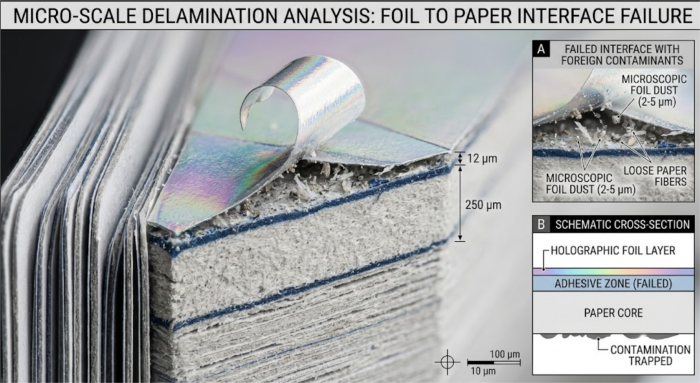
When playing cards are die-cut, the heavy industrial blades leave behind a microscopic layer of paper dust on the collective edge of the deck. Cheap factories skip the tedious cleaning process and apply the hot foil directly over this loose debris. The result? The holographic film bonds to the dust instead of the solid paper core. The moment your backer bridges a shuffle, that dust dislodges, taking your expensive foil with it.
Culprit 2: Rushed Curing and Thermal Shock
Applying holographic foil requires intense heat—typically between 120°C and 135°C—and immense pressure to weld the micro-embossed film to the paper fibers. Once applied, the deck needs time to cool and stabilize. Mass-production factories rushing to meet tight shipping deadlines will often take hot, freshly gilded decks and immediately move them to cold packing rooms. This drastic temperature drop causes thermal shock, creating invisible micro-cracks in the foil that eventually lead to severe flaking.
Culprit 3: The Moisture Expansion Trap
Cardstock is fundamentally porous. If you ship a deck manufactured in a dry facility to a backer living in a humid coastal city, the paper core will naturally absorb moisture and expand. Holographic foil, however, has zero stretch. If the factory did not apply a moisture-blocking primer before applying the foil, the swelling paper will physically tear the foil apart from the inside out.
The VNK Solution: The Molecular Edge-Lock Protocol
Instead of cutting corners, we re-engineered the process.
At VNK Playing Card, we don’t treat holographic gilding as a decorative afterthought. We treat it as an engineering challenge. To protect the integrity of your artwork and your brand’s reputation, we developed a rigid three-step protocol that guarantees a permanent, scratch-resistant edge.
Step 1: 0.1mm Micro-Sanding & Vacuuming
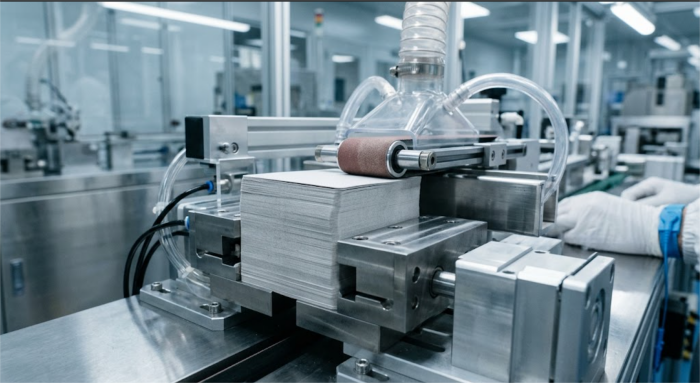
Before a single strip of foil touches your deck, we physically sand 0.1mm off the collective edge of the cards. This removes all die-cut imperfections and smooths out the micro-fissures. We then run the decks through a high-powered industrial vacuum system to ensure the foil bonds directly to raw, virgin paper fibers—not leftover dust.
Step 2: Elastic Primer Application
To combat global humidity changes during shipping, we apply a proprietary, ultra-thin elastic primer to the card edges before the hot-stamping phase. This creates a flexible buffer zone between the porous paper core and the rigid metallic foil, allowing the cards to breathe and expand slightly without fracturing the holographic finish.
Step 3: The 48-Hour Curing Vault
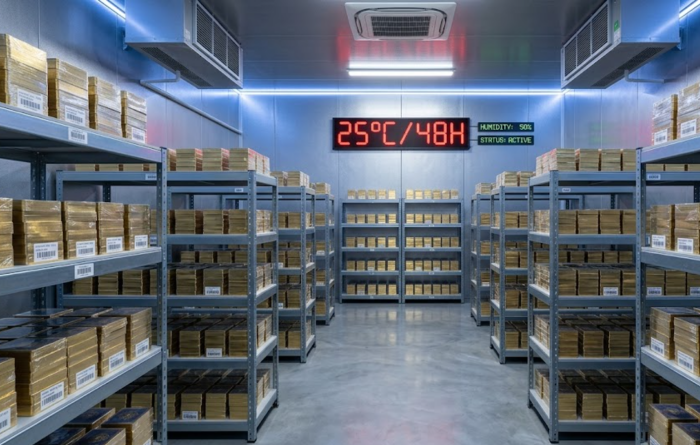
In our facility, patience is non-negotiable. Every gilded deck is mandated to rest in a climate-controlled curing vault at a strict 25°C for exactly 48 hours. This allows the thermal-activated adhesives to cross-link and lock into the paper fibers on a molecular level before they are ever touched by shrink-wrap or packed into master cartons.
Ready to print a deck that lasts? [Contact us today / Insert Your Link Here] to discuss your next project.